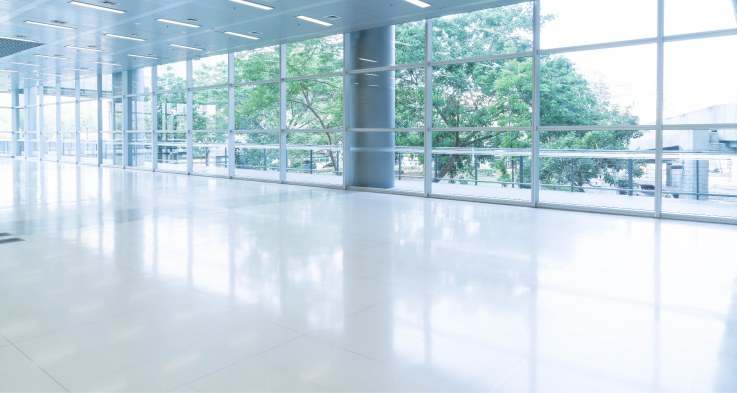
The floor is one of the hardest-working surfaces in any warehouse, plant or shop. It carries forklifts and pallet jacks, takes chemical spills and hot tires, and has to stay safe and easy to clean through Edmonton winters, when snow, slush and de-icing salt get tracked in at every door. For most industrial buildings the choice comes down to two systems: an epoxy coating or a polished concrete floor. Both are durable and both can last for many years. They suit different buildings for different reasons.
How each system works
Epoxy is a coating. After the slab is ground and repaired, a resin system is applied over it in one or more coats, forming a continuous, seamless layer on top of the concrete. It can be built up to different thicknesses, coloured, and finished with a textured or broadcast surface for slip resistance.
Polished concrete works with the slab itself. The concrete is ground in stages with progressively finer diamond tooling, treated with a densifier that hardens the surface, and polished to the sheen you want. There is no separate coating to wear through or peel.
Epoxy: where it fits best
- Chemical and spill resistance. A sealed, non-porous surface resists oils, fuels and many chemicals, which suits shops, maintenance bays, food and beverage areas and light manufacturing.
- Line marking and colour. Safety walkways, forklift lanes, storage zones and colour-coded areas can be built into the system.
- Covering a tired slab. Epoxy can hide cosmetic wear and patching on an older floor once it has been properly repaired.
- Trade-offs. Coatings wear in high-traffic lanes and need recoating over time, and they depend on good bonding. Moisture coming up through the slab is a common cause of blistering and peeling, so moisture testing before installation is essential.
Polished concrete: where it fits best
- Very heavy traffic. With no coating to wear through, polished concrete handles constant forklift traffic well and does not peel.
- Low maintenance. Routine cleaning is simple, and the densified surface reduces concrete dusting.
- Bright, reflective finish. A polished floor reflects light, which suits distribution centres, showrooms and large open warehouses.
- Trade-offs. The finished look depends on the slab you start with, so cracks, patches and aggregate will show. It is more porous than a coating, so spills should be cleaned up promptly, and smooth polished concrete can become slippery when wet, which matters at entrances in an Edmonton winter.
What matters in Edmonton
- Slab moisture. New slabs need time to cure before coatings go down, and older slabs on grade can carry moisture. Testing first prevents most coating failures.
- Winter entrances. Snowmelt and de-icing salt at overhead doors and entrances call for slip-resistant finishes, walk-off areas and a surface that cleans up easily.
- Temperature during installation. Coatings have minimum temperature requirements while they cure, which affects scheduling in unheated buildings during the colder months.
- Downtime. An epoxy floor can usually take light foot traffic within about 24 hours and needs around 72 hours to fully cure before heavy equipment and vehicle traffic. Plan installation around shutdowns, weekends or phased areas so operations can keep running.
Quick comparison
- Chemical-heavy areas, shops, food and beverage: epoxy is usually the better fit.
- Large warehouses with constant forklift traffic: polished concrete is usually the better fit.
- Walkways, line marking and colour coding: epoxy.
- Lowest long-term maintenance on a sound slab: polished concrete.
- Many buildings use both: polished concrete across the warehouse floor, epoxy in shops, wash bays and production areas.
Preparation decides the result
Whichever system you choose, most floor failures trace back to preparation: grinding, crack and joint repair, levelling and moisture testing. Ask any flooring contractor how they will prepare your slab, not just what product they will install.
Industrial flooring from Reno King
Reno King General Contractors supplies and installs epoxy and polished concrete floors, along with VCT and commercial rubber flooring for offices, lunchrooms and shop areas, on industrial projects across Edmonton. We work for general contractors, developers and property managers, and can schedule installation around your operations. See our commercial flooring services, or send us your drawings and finish schedule through our contact page or call 780-271-0068 for an itemized quote.